Digifesto

Hadoop with Scala: hacking notes

I am trying to learn how to use Hadoop. I’m am trying to learn to program in Scala. I mostly forget how to program in Java. In this post I will take notes on things that come up as I try to get my frickin’ code to compile so I can run a Hadoop job.

There was a brief window in my life when I was becoming a good programmer. It was around the end of my second year as a professional software engineer that I could write original code to accomplish novel tasks.

Since then, the tools and my tasks have changed. For the most part, my coding has been about projects for classes, really just trying to get a basic competence in commodity open tools. So, my “programming” consists largely of cargo-culting code snippets and trying to get them to run in a slightly modified environment.

Right now I’ve got an SBT project; I’m trying to write a MapReduce job in Scala that will compile as a .jar that I can run on Hadoop.

One problem I’m having is there are apparently several different coding patterns for doing this, and several frameworks that are supposed to make my life easier. These include SMR, Shadoop, and Scalding. But since I’m doing this for a class and I actually want to learn something about how Hadoop works, I’m worried about having to good a level of abstraction.

So I’m somewhat perversely taking the Scala Wordcount example from jweslley’s Shadoop and make it dumber. I.e., not use Shadoop.

One thing that has been confusing as hell is that there Hadoop has a Mapper interface and a Mapper class, both with map() functions (1,2), but those functions haved different type signatures.

I started working with some other code that used the second map() function. One of the arguments to this function is of type Mapper.Context. I.e., the Context class is a nested member of the Mapper class. Unfortunately, referencing this class within Scala is super hairy. I saw a code snippet that did this:

override def map(key:Object, value:Text, context:Mapper[Object,Text,Text,IntWritable]#Context) = {
    for (t <-  value.toString().split("\\s")) {
      word.set(t)
      context.write(word, one)
    }
  }

But I couldn’t get this thing to compile. Kept getting this awesome error:

type Context is not a member of org.apache.hadoop.mapred.Mapper[java.lang.Object,org.apache.hadoop.io.Text,org.apache.hadoop.io.Text,org.apache.hadoop.io.IntWritable]

Note the gnarliness here. It’s not super clear whether or how Context is parameterized by the type parameters of Mapper. The docs for the Mapper class make it seem like you can refer to Context without type parameterization within the code of the class extending Mapper. But I didn’t see that until I had deleted everything and tried a different track, which was to use the Mapper interface in a class extending MapReduceBase.

Oddly, this interface hides the Context mechanic and instead introduces the Reporter class as a final argument to map(). I find this less intimidating for some reason. Probably because after years of working in Python and JavaScript my savvinness around the Java type hierarchy is both rusty and obsolete. With the added type magicalness of Scala to add complexity to the mix, I think I’ve got to steer towards the dumbest implementation possible. And at the level I’m at, it looks like I don’t ever have to touch or think about this Reporter.

So, now starting with the example from Shadoop, now I just need to decode the Scala syntactic sugar that Shadoop provides to figure out what the hell is actually going on.

Consider:

  class Map extends MapReduceBase with Mapper[LongWritable, Text, Text, IntWritable] {

    val one = 1

    def map(key: LongWritable, value: Text, output: OutputCollector[Text, IntWritable], reporter: Reporter) =
      (value split " ") foreach (output collect (_, one))
  }

This is beautiful concise code. But since I want to know something about the underlying program I’m going to uglify it by removing the implict conversions provided by Shadoop.

The Shadoop page provides a Java equivalent for this, but that’s not really what I want either. For some reason I demand the mildy more concise syntax of Scala over Java but not the kind of condensed, beautiful syntax Scala makes possible with additional libraries.

This compiles at least:

  class Map extends MapReduceBase with Mapper[LongWritable, Text, Text,
 IntWritable] {   

    val one = new IntWritable(1); 

    def map(key: LongWritable, value: Text, output: OutputCollector[Text,
     IntWritable], reporter: Reporter) = {
      var line = value.toString();

      for(word <- line.split(" ")){
        output.collect(new Text(word), one)
      }
    }
  }

What I find a little counterintuitive about this is that the OutputCollector doesn’t act like a dictionary, overwriting the key-value pair with each call to collect(). I guess since I’m making a new Text object with each new entry, that makes sense even if the collector is implemented as a hash map of some kind. (Shadoop hides this mechanism with implicit conversions, which is rad of course.)

Next comes the reducer. The Shadoop code is this:

def reduce(key: Text, values: Iterator[IntWritable],
            output: OutputCollector[Text, IntWritable], reporter: Reporter) = {
  val sum = values reduceLeft ((a: Int, b: Int) => a + b)
  output collect (key, sum)
}

Ok, so there’s a problem here. The whole point of using Scala to code a MapReduce job is so that you can use Scala’s built in reduceLeft function inside the reduce method of the Reducer. Because functional programming is awesome. By which I mean using built-in functions for things like map and reduce operations are awesome. And Scala supports functional programming, in at the very least that sense. And MapReduce as a computing framework is at least analogous to that paradigm in functional programming, and even has the same name. So, OMG.

Point being, no way in hell am I going to budge on this minor aesthetic point in my toy code. Instead, I’m going to brazenly pillage jweslley’s source code for the necessary implicit type conversion.

  implicit def javaIterator2Iterator[A](value: java.util.Iterator[A]) = new Iterator[A] {
    def hasNext = value.hasNext
    def next = value.next
  }

But not the other implicit conversions that would make my life easier. That would be too much.

Unfortunately, I couldn’t get this conversion to work right. Attempting to run the code gives me the following error:

[error] /home/cc/cs294/sp13/class/cs294-bg/hw3/wikilearn/src/main/scala/testIt/WordCount.scala:33: type mismatch;
[error]  found   : java.util.Iterator[org.apache.hadoop.io.IntWritable]
[error]  required: Iterator[org.apache.hadoop.io.IntWritable]
[error]       val sum = (values : scala.collection.Iterator[IntWritable]).reduceLeft (
[error]                  ^

It beats me why this doesn’t work. In my mental model of how implicit conversion is supposed to work, the java.util.Iterator[IntWritable] should be caught by the parameterized implicit conversion (which I defined within the Object scope) and converted no problemo.

I can’t find any easy explanation of this on-line at the moment. I suspect it’s a scoping issue or a limit to the parameterization of implicit conversions. Or maybe because Iterator is a trait, not a class? Instead I’m going to do the conversion explicitly in the method code.

After fussing around for a bit, I got:

    def reduce(key: Text, values: java.util.Iterator[IntWritable],                                                               
      output: OutputCollector[Text, IntWritable], reporter: Reporter) = {                                                        
      val svals = new scala.collection.Iterator[IntWritable]{
        def hasNext = values.hasNext
        def next = values.next
      }
      val sum = (svals : scala.collection.Iterator[IntWritable])\|
.reduceLeft (
       (a: IntWritable, b: IntWritable) => new IntWritable(a.get() + b.get())}
      ) 
      output collect (key, sum)
    }

…or, equivalently and more cleanly:

    def reduce(key: Text, values: java.util.Iterator[IntWritable],
      output: OutputCollector[Text, IntWritable], reporter: Reporter) = {

      val svals = new scala.collection.Iterator[Int]{
        def hasNext = values.hasNext
        def next = values.next.get
      }

      val sum = (svals : scala.collection.Iterator[Int]).reduceLeft (
        (a: Int, b: Int) => a + b
      )
      output collect (key, new IntWritable(sum))
    }
  }

I find the Scala syntax for defining the methods of an abstract class here pretty great (I hadn’t encountered it before). Since Iterator[A] is an abstract class, you define the methods next and hasNext inside the curly braces. What an elegant way to let people subclass abstract classes in an ad hoc way!

There’s one more compile error I had to bust around. This line was giving me noise:

conf setOutputFormat classOf[TextOutputFormat[_ <: WritableComparable, _ <: Writable]]

It was complaining that WriteComparable needed a type parameter. Not confident I could figure out exactly which parameter to set, I just made the signature tighter.

conf setOutputFormat classOf[TextOutputFormat[Text, IntWritable]]

Only then did I learn that JobConf is a deprecated way of defining jobs. So I rewrote WordCount object into a class implementing the Tool interface, using this Java snippet as an example to work from. To do that, I had to learn the to write a class that extends two interfaces in Scala, you need to use a “extends X with Y” syntax. Also, for trivial conditionals Scala dispenses with Java’s ternary X ? Y : Z operator in favor of a single line if (X) Y else Z. Though I will miss the evocative use of punctuation in the ternary construct, I’ve got to admit that Scala is keeping it real classy here.

Wait…ok, so I just learned that most of the code I was cargo culting was part of the deprecated coding pattern, which means I now have to switch it over to the new API. I learned this from somebody helpful in the #hadoop IRC channel.

[23:31]  what's the deal with org.apache.hadoop.mapreduce.Mapper and org.apache.hadoop.mapred.Mapper ??
[23:31]  is one of them deprecated?
[23:31]  which should I be using?
[23:32]  sbenthall: Use the new API
[23:32]  sbenthall: (i.e. mapreduce.*) both are currently supported but eventually the (mapred.*) may get deprecated
[23:32]  ok thanks QwertyM
[23:33]  sbenthall: as a reference, HBase uses mapreduce.* APIs completely for its provided MR jobs; and I believe Pig too uses the new APIs
[23:33]  is MapReduceBase part of the old API?
[23:33]  sbenthall: yes, its under the mapred.* package
[23:33]  ok, thanks.

Parachuting into the middle of a project has it’s drawbacks, but it’s always nice when a helpful community member can get you up to speed. Even if you’re asking near midnight on a Sunday.

Wait. I realize now that I’ve come full circle.

See, I’ve been writing these notes over the course of several days. Only just now am I realizing that I’m not going back to where I started, with the Mapper class that takes the Context parameter that was giving me noise.

Looking back at the original error, it looks like that too was a result of mixing two API’s. So maybe I can now safely shift everything BACK to the new API, drawing heavily on this code.

It occurs to me that this is one of those humbling programming experiences when you discover that the reason why your thing was broken was not the profound complexity of the tool you were working with, but your own stupidity over something trivial. This happens to me all the time.

Thankfully, I can’t ponder that much now, since it’s become clear that the instructional Hadoop cluster on which we’ve been encouraged to do our work are highly unstable. So I’m going to take the bet that it will be more productive for me to work locally, even if that means installing Hadoop locally on my Ubuntu machine.

I thought I was doing pretty good with the installation until I got to the point of hitting the “ON” switch on Hadoop. I got this:

sb@lebensvelt:~$ /usr/local/hadoop/bin/start-all.sh 
Warning: $HADOOP_HOME is deprecated.

starting namenode, logging to /usr/local/hadoop/libexec/../logs/hadoop-sb-namenode-lebensvelt.out
localhost: ssh: connect to host localhost port 22: Connection refused
starting jobtracker, logging to /usr/local/hadoop/libexec/../logs/hadoop-sb-jobtracker-lebensvelt.out
localhost: ssh: connect to host localhost port 22: Connection refused

I googled around and it looks like this problem is due to not having an SSH server running locally. Since I’m running Ubuntu, I went ahead and followed these instructions. In the process I managed to convince my computer that I was undergoing a man-in-the-middle attack between myself and myself.

I fixed that with

$ ssh-keygen -R localhost

and successfully got Hadoop running with

$ /usr/local/hadoop/bin/start-all.sh 

only to be hung up on this error

$ hadoop fs -ls
Warning: $HADOOP_HOME is deprecated.

ls: Cannot access .: No such file or directory.

which somebody who runs an Indian matrimony search engine had run into and documented the fix for. (Right way to spell it is

hadoop fs -ls .

With an extra dot.)

There’s a point to me writing all this out, by the way. An important part of participation in open source software, or the hacker ethic in general, is documenting ones steps so that others who follow the same paths can benefit from what you’ve gone through. I’m going into a bit more detail about this process than really helpful because in my academic role I’m dealing with a lot of social scientist types who really don’t know what this kind of work entails. Let’s face it: programming is a widely misunderstood discipline which seems like an utter mystery to those that aren’t deeply involved in it. Much of this has to do with the technical opacity of the work. But another part of why its misunderstood is because problem solving in the course of development depends on a vast and counter-intuitive cyberspace of documentation (often generated from code comments, so written by some core developer), random blog posts, chat room conversations, forum threads. Easily 80% of the work when starting out on a new project like this is wrestling with all the minutia of configuration on a particular system (operating system and hardware contingent, in many cases) and idioms of programming language and environment.

The amount of time it takes to invest in any particular language or toolkit necessarily creates a tribalism among developers because their identities wind up being intertwined with the tools they use. As I hack on this thing, however incompetently, I’m becoming a Scala developer. That’s similar to saying that I’m becoming a German speaker. My conceptual vocabulary, once I’ve learned how to get things done in Scala, is going to be different than it was before. In fact, that’s one of the reasons why I’m insisting on teaching myself Scala in the first place–because I know that it is a conceptually deep and rigorous language which will have something to teach me about the Nature of Things.

Some folks in my department are puzzled at the idea that technical choices in software development might be construed as ethical choices by the developers themselves. Maybe it’s easier to understand that if you see that in choosing a programming language you are in many ways choosing an ontology or theoretical framework through which to conceive of problem-solving. Of course, choice of ontology will influence ones ethical principles, right?

But I digress.

So I have Hadoop running on my laptop now, and a .jar file that compiles in SBT. So now all I need to do is run the .jar using the hadoop jar command, right?

Nope, not yet…

Exception in thread "main" java.lang.NoClassDefFoundError: scala/ScalaObject

OK, so I the problem is that I haven’t included scala-library.jar on my Hadoop runtime classpath.

I solved this by making a symbolic link from the Hadoop /lib directory to the .jar in my Scala installation.

ln -s /usr/local/share/scala-2.9.2/lib/scala-library.jar /usr/local/hadoop/lib/scala-library.jar

That seemed to work, only now I have the most mundane and inscrutable of Java errors to deal with:

Exception in thread "main" java.lang.NullPointerException
	at sun.reflect.NativeMethodAccessorImpl.invoke0(Native Method)
	at sun.reflect.NativeMethodAccessorImpl.invoke(NativeMethodAccessorImpl.java:57)
	at sun.reflect.DelegatingMethodAccessorImpl.invoke(DelegatingMethodAccessorImpl.java:43)
	at java.lang.reflect.Method.invoke(Method.java:601)
	at org.apache.hadoop.util.RunJar.main(RunJar.java:156)

I had no idea how to proceed from here. This time, no helpful folks in the #hadoop channel helped me either.

So once again I switched to a new hunk of code to work from, this time the WordCount.scala file from Derrick Cheng’s ScalaOnHadoop project. Derrick posted a link to this project on our course’s Piazza earlier, which was awesome.

Another digression. There’s a lot of talk now about on-line education. People within the university context feel vaguely threatened by MOOCs, believing that there will be a superstar effect that advantages first movers, but many are uncomfortable making that first move. Taek Lim in my department is starting to studying user interfaces to support collaboration in on-line learning.

My own two cents on this are that the open software model is about as dynamics a collaborative environment as you can get, and at the point when people started to use our course discussion management system, Piazza, as if it were a forum to discuss the assignment almost as if it was an open source mailing list, we started to get a lot more out of it and learned a lot from each other. I’m not the first person to see this potential of the open source model for education, of course. I’m excited to be attending the POSSE workshop, which is about that intersection, this summer. At this rate, it looks like I will be co-teaching a course along these lines in the Fall targeted at the I School Masters students, which is exciting!

So, anyway, I’m patching Derrick Cheng’s code. I’m not working with BIDMat yet so I’m leaving that out of the build, so I remove all references to that and I get the thing to compile…and run! I got somebody else’s Scala WordCount to run!

This seems like such a triumph. It’s taken a lot of tinkering and beating my head against a wall to get this far. (Not all at once–I’ve wrote this post over the course of several days. I realize that it’s a little absurd.)

But wait! I’m not out of the woods yet. I check the output of my MapReduce job with

hadoop fs -cat test-output/part-r-00000

and the end of my output file looks like this:

§	1
§	1
§	1
§	1
§	1
§	1
§	1
§	1
§	1
Æschylus	1
Æsop	1
Æsop	1
Æsop	1
É	1
Élus,_	1
à	1
à	1
à	1
æons	1
æsthetic	1
è	1
è	1
è	1
état_.	1
The	1
The	1

What’s going on here? Well, it looks like I successfully mapped each occurrence of each word in the original text to a key-value pair. But something went wrong in the reduce step, that was supposed to combine all the occurrences into a single count for each word.

That is just fine for me, because I’d rather be using my own Reduce function. Because it uses Scala’s functional reduceLeft, which is sweet! Why even write a Map Reduce job in a functional programming language if you can’t use a built=in language reduce in the Reduce step?

Ok, mine doesn’t work either.

Apparently, the reason for this is that the type signature I’ve been using for the Reducer’s reduce method has been wrong all along. And when that happens, the code compiles but Reducer runs its default reduce function, which is the identity function.

It’s almost (almost!) as if it would have made more sense to start by just reading the docs and following the instructions.

Now I have edited the map and reduce functions so that they have the right type signatures. To get this right exactly, I looked at a different file. I also tinkered

At last, it works.

Now, at last, I understand how this Context member class works. The problem was that I was trying to use it with the mapred.Mapper class from the old API. So much of my goose chase was due to not reading things carefully enough.

On the other hand, I feel enriched by the whole meandering process. Realizing that my programming faults were mine and not due to the complexity of the tools I was using paradoxically gives me more confidence in my understanding of the tools moving forward. And engaging with the distributed expertise on the subject–through StackOverflow, documentation generated from the original coders, helpful folks on IRC, blog posts, and so on–is much more compelling when one is driven by concrete problem-solving goals, even when those goals are somewhat arbitrary. Had I learned to use Hadoop in a less circuitous way, my understanding would probably be much more brittle. I am integrating new knowledge of Hadoop, Scala, and Java (it’s been a long time) with existing background knowledge. After a good night’s sleep, with any luck it will be part of my lifeworld!

This is the code I wound up with, by the way. I don’t suggest you use it.
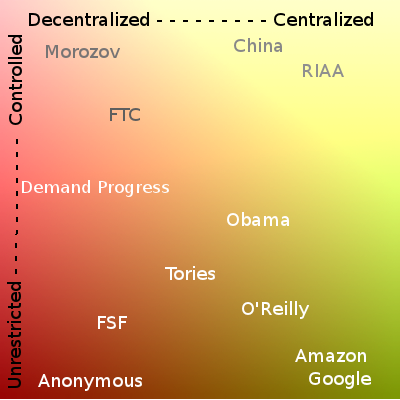
the technical political spectrum?

Since the French Revolution, we have had the Left/Right divide in politics.

Probably seven or so years ago, some people got excited about thinking about a two-dimensional political spectrum. There were Economic and Social dimensions. You could be in one of four quadrants: Libertarian, Social Democrat, Totalitarian, or Conservative.

Technology is getting more political and politicized. Have we figured out the spectrum yet?

Because there’s been a lot of noise about their beef, lets assume as a first pass that O’Reilly and Morozov give us some sense of the space. The problem is that there’s a good chance the “debate” between them is giving off a lot more heat than light, so it’s not clear if there’s a substantive political difference.

Let me try to take a constructive crack at it. I don’t think I’m going to get it right, but I’m curious to know how much this resonates and if others would map things differently.

A two-dimensional representation of the continuum of technical politics, with unscientifically plotted representatives

A two-dimensional representation of the continuum of technical politics, with unscientifically plotted representatives

Some people think that “technology”, by which most people mean technology companies, should be replacing more and more of the functions of government. I think the peer progressives are in this camp, as are the institutionalized nudgers in the UK Conservative party, who would prefer to shrink the state. There’s a fair argument that the “open government” people are trying to shrink government by giving non-state actors the ability to provide services that the state might otherwise provide. Through free flow of information and greater connectivity, we can spur vibrancy in civil society and perfect the market.

Others think that the state needs to have a strong role in regulating technology companies to make sure they don’t abuse their power. There’s a lot of that going around in my department at UC Berkeley. These people see that democratic state as the best representative of citizen’s interests. The FTC and Congress need to help ensure, e.g., people’s privacy. Maybe Morozov is in here somewhere. Monopoly concentrations of technical power are threatening to the public interest; technical platforms should be decentralized and controlled so that politics is not overwhelmed by an illegitimate technocracy.

Another powerful group, the Copyright lobby, is economically threatened by new technology and so wants to restrict its use. Telecom companies would like to effectively meter flow of information. Maybe it’s a stretch, but perhaps we could include the military-industrial complex and its desire to instrument the Web for surveillance purposes in this camp as well. These groups tend to not want technology to change, or to tightly control that technology.

Then there’s the Free Software movement. And Stanford’s Liberation Technology folks, if I understand them correctly. And maybe Anonymous is in here somewhere. Pro-technology, generally skeptical of both state and corporate interests.

So maybe what’s going on is that we have a two-dimensional political space.

In one dimension, we have Centralization versus Decentralization. Richly interconnected platforms managed by an elite with tight arrangements for data sharing, versus a much more loosely connected set of networks where the lines of power are less clear.

In the other dimension, we have Unrestricted versus Controlled. Either the technical organizations should be free to persue their own interests, or they should be regulated by non- (or at least less) technical political forces, such as the state.

What do you think?

the social intelligence of spotted hyenas

The best thing I did today was stop by for the beginning of Kay Holekamp‘s talk on “Social Complexity and the Evolution of Intelligence.”

Her work involves researching spotted hyenas.

Spotted hyenas live in clans of about a hundred hyenas, which contain several martilineal kinship groups each. Female hyenas have an observable social hierarchy that is caused by and a cause of survival “fitness”.  Male hyenas migrate to a different clan before reproducing.

This is very similar to the social structure of certain primates, like baboons.  It is nothing like the social structure of cats and dogs (hyenas are somewhere in between the two, closer to cats.)

What’s interesting about the research is that without exception, results about the social cognitive capabilities of primates is, without exception, reproducible in spotted hyenas.

That means that the same capacities for social intelligence has been achieved by multiple species through convergent evolution.

deep thoughts by jack handy

Information transfer just is the coming-into-dependence of two variables, which under the many worlds interpretation of quantum mechanics means the entanglement of the “worlds” of each variable (and, by extension, the networks of causally related variables of which they are a part). Information exchange collapses possibilities.
This holds up whether you take a subjectivist view of reality (and probability–Bayesian probability properly speaking) or an objectivist view. At their (dialectical?) limit, the two “irreconcilable” paradigms converge on a monist metaphysics that is absolutely physical and also ideal. (This was recognized by Hegel, who was way ahead of the game in a lot of ways.) It is the ideality of nature that allows it to be mathematized, though its important to note that mathematization does not exclude engagement with nature through other modalities, e.g. the emotional, the narrative, etc.

This means that characterizing the evolution of networks of information exchange by their physical properties (limits of information capacity of channels, etc.) is something to be embraced to better understand their impact on e.g. socially constructed reality, emic identity construction, etc. What the mathematics provide is a representation of what remains after so many diverse worlds are collapsed.

A similar result, representing a broad consensus, might be attained dialectically, specifically through actual dialog. Whereas the mathematical accounting is likely to lead to reduction to latent variables that may not coincide with the lived experience of participants, a dialectical approach is more likely to result in a synthesis of perspectives at a higher level of abstraction. (Only a confrontation with nature as the embodiment of unconscious constraints is likely to force us to confront latent mechanisms.)

Whether or not such dialectical synthesis will result in a singular convergent truth is unknown, with various ideologies taking positions on the matter as methodological assumptions. Haraway’s feminist epistemology, eschewing rational consensus in favor of interperspectival translation, rejects a convergent (scientific, and she would say masculine) truth. But does this stand up to the simple objection that Haraway’s own claims about truth and method transcend individual perspective, making he guilty of performative contradiction?

Perhaps a deeper problem with the consensus view of truth, which I heard once from David Weinberger, is that the structure of debate may have fractal complexity. The fractal pluralectic can fray into infinite and infinitesimal disagreement at its borders. I’ve come around to agreeing with this view, uncomfortable as it is. However, within the fractal pluralectic we can still locate a convergent perspective based on the network topology of information flow. Some parts of the network are more central and brighter than others.

A critical question is to what extent the darkness and confusion in the dissonant periphery can be included within the perspective of the central, convergent parts of the network. Is there necessarily a Shadow? Without the noise, can there be a signal?

Bay Area Rationalists

There is an interesting thing happening. Let me just try to lay down some facts.

There are a number of organizations in the Bay Area right now up to related things.

  • Machine Intelligence Research Institute (MIRI). Researches the implications of machine intelligence on the world, especially the possibility of super-human general intelligences. Recently changed their name from the Singularity Institute due to the meaninglessness of the term Singularity. I interviewed their Executive Director (CEO?), Luke Meuhlhauser, a while back. (I followed up on some of the reasoning there with him here).
  • Center for Applied Rationality (CFAR). Runs workshops training people in rationality, applying cognitive science to life choices. Trying to transition from appearing to pitch a “world-view” to teaching a “martial art” (I’ve sat in on a couple of their meetings). They aim to grow out a large network of people practicing these skills, because they think it will make the world a better place.
  • Leverage Research. A think-tank with an elaborate plan to save the world. Their research puts a lot of emphasis on how to design and market ideologies. I’ve been told that they recently moved to the Bay Area to be closer to CFAR.

Some things seem to connect these groups. First, socially, they all seem to know each other (I just went to a party where a lot of members of each group were represented.) Second, the organizations seem to get the majority of their funding from roughly the same people–Peter Thiel, Luke Nosek, and Jaan Tallinn, all successful tech entrepreneurs turned investors with interest in stuff like transhumanism, the Singularity, and advancing rationality in society. They seem to be employing a considerable number of people to perform research on topics normally ignored in academia and spread an ideology and/or set of epistemic practices. Third, there seems to be a general social affiliation with LessWrong.com; I gather a lot of the members of this community originally networked on that site.

There’s a lot that’s interesting about what’s going on here. A network of startups, research institutions, and training/networking organizations is forming around a cluster of ideas: the psychological and technical advancement of humanity, being smarter, making machines smarter, being rational or making machines to be rational for us. It is as far as I can tell largely off the radar of “mainstream” academic thinking. As a network, it seems concerned with growing to gather into itself effective and connected people. But it’s not drawing from many established bases of effective and connected people (the academic establishment, the government establishment, the finance establishment, “old boys networks” per se, etc.) but rather is growing its own base of enthusiasts.

I’ve had a lot of conversations with people in this community now. Some, but not all, would compare what they are doing to the starting of a religion. I think that’s pretty accurate based on what I’ve seen so far. Where I’m from, we’ve always talked about Singularitarianism as “eschatology for nerds”. But here we have all these ideas–the Singularity, “catastrophic risk”, the intellectual and ethical demands of “science”, the potential of immortality through transhumanist medicine, etc.–really motivating people to get together, form a community, advance certain practices and investigations, and proselytize.

I guess what I’m saying is: I don’t think it’s just a joke any more. There is actually a religion starting up around this. Granted, I’m in California now and as far as I can tell there are like sixty religions out here I’ve never heard of (I chalk it up to the lack of population density and suburban sprawl). But this one has some monetary and intellectual umph behind it.

Personally, I find this whole gestalt both attractive and concerning. As you might imagine, diversity is not this group’s strong suit. And its intellectual milieu reflects its isolation from the academic mainstream in that it lacks the kind of checks and balances afforded by multidisciplinary politics. Rather, it appears to have more or less declared the superiority of its methodological and ideological assumptions to its satisfaction and convinced itself that it’s ahead of the game. Maybe that’s true, but in my own experience, that’s not how it really works. (I used to share most of the tenets of this rationalist ideology, but have deliberately exposed myself to a lot of other perspectives since then [I think that taking the Bayesian perspective seriously necessitates taking the search for new information very seriously]. Turns out I used to be wrong about a lot of things.)

So if I were to make a prediction, it would go like this. One of these things is going to happen:

  • This group is going to grow to become a powerful but insulated elite with an expanded network and increasingly esoteric practices. An orthodox cabal seizes power where they are able, and isolates itself into certain functional roles within society with a very high standard of living.
  • In order to remain consistent with its own extraordinarily high epistemic standards, this network starts to assimilate other perspectives and points of view in an inclusive way. In the process, it discovers humility, starts to adapt proactively and in a decentralized way, losing its coherence but perhaps becomes a general influence on the preexisting societal institutions rather than a new one.
  • Hybrid models. Priesthood/lay practitioners. Or denominational schism.

There is a good story here, somewhere. If I were a journalist, I would get in on this and publish something about it, just because there is such a great opportunity for sensationalist exploitation.

Spaghetti, meet wall (on public intellectuals, activists in residence, and just another existential crisis of a phd student)

I have a backlog of things I’ve been planning to write about. It’s been a fruitful semester for me, in a number of ways. At the risk of being incoherent, I thought I’d throw some of my spaghetti against the Internet wall. It’s always curious to see what sticks.

One of the most fascinating intellectual exchanges of the past couple months for me was what I’d guess you could call the Morozov/Johnson debate. Except it wasn’t a debate. It was a book, then a book review (probably designed to sell a different book), and a rebuttal. It was fantastic showmanship. I have never felt so much like I was watching a boxing match while reading stuff on the Internet.

But what really made it for me was the side act of Henry Farrell taking Morozov to task. Unlike the others, I’ve met Farrell. He was kind enough to talk to me about his Cognitive Democracy article (which I was excited about) and academia in general (“there are no academic jobs for brilliant generalists”) last summer when I was living in DC. He is very smart, and not showy. What was cool about his exchange with Morozov was that it showed how a debate that wasn’t designed to sell books could still leak out into the public. There’s still a role for the dedicated academic, as a watchdog on public intellectuals who one could argue have to get sloppier to entertain the public.

An intriguing fallout from (or warm up to?) the whole exchange was Morozov casually snarking Nick Grossman‘s title, “Activist in Residence” at a VC fund in a tweet (“Another sign of the coming Apocalypse? Venture capital firms now have “activists in residence”? “), which then triggered some business press congratulating Nick for being “out in the streets”. Small world, I used to work with Nick at OpenPlans, and can vouch for his being a swell guy with an experienced and nuanced view of technology and government. He has done a lot of pioneering, constructive work on open governance applications–just the sort of constructive work a hater like Morozov would hate if he looked into it some. Privately, he’s told me he’s well aware of the potential astroturfing connotations of his title.

I got mixed feelings about all this. I’m suspicious of venture capital for the kind of vague “capital isn’t trustworthy” reasons you pick up in academia. Activism is sexy, lobbyists are not, and so if you can get away with calling your lobbyist an activist in residence then clearly that’s a step up.

But I think there’s something a little more going on here, which has to do with the substance of the debate. As I understand it, the Peer Progressives believe that social and economic progress can happen through bottom-up connectivity supported by platforms that are potentially run for profit. If you’re a VC, you’d want to invest in one of them platforms, because they are The Future. Nevertheless, you believe stuff happens by connecting people “on the ground”, not targeting decision-makers who are high in a hierarchy.

In Connected, Christakis and Fowler (or some book like it, I’m been reading a lot of them lately and having a hard time keeping track) make the interesting argument that the politics of protesters in the streets and lobbyists aren’t much different. What’s different is the centrality of the actor in the social network of governance. If you know a lot of senators, you’re probably a lobbyist. If you have to hold a sign and shout to have your political opinions heard, then you might be an activist.

I wonder who Nick talks to. Is he schmoozing with the Big Players? Or is he networking the base and trying to spur coordinated action on the periphery? I really have no idea. But if it were the latter, maybe that would give credibility to his title.

Another difference between activists and lobbyists is their authenticity. I have no doubt that Nick believes what he writes and advocates for. I do wonder how much he restrains himself based on his employers’ interests. What would prove he was an activist, not a lobbyist, would be if he were given a longer leash and allowed to speak out on controversial issues in a public way.

I’m mulling over all of this because I’m discovering in grad school that as an academic, you have to pick an audience. Are you targeting your work at other academics? At the public? At the press? At the government? At industry? At the end of the day, you’re writing something and you want somebody else to read it. If I’m lucky, I’ll be able to build something and get some people to use it, but that’s an ambitious thing to attempt when you’re mainly working alone.

So far some of my most rewarding experiences writing in academia have been blogging. It doesn’t impress anybody important but a traffic spike can make you feel like you’re on to something. I’ve been in a world of open work for a long time, and just throwing the spaghetti and trying to see what sticks has worked well for me in the past.

But if you try to steer yourself deeper into the network, the stakes get higher. Things get more competitive. Institutions are more calcified and bureaucratic and harder to navigate. You got to work to get anywhere. As it should be.

Dang, I forgot where I was going with this.

Maybe that’s the problem.

twitter’s liberal bias

Pew Research Center recently put out a report on Twitter’s liberal bias. It argues that overall sentiment on certain political events on Twitter is far to the left of national surveys. Also, people on Twitter complain a lot (are more negative). That makes sense, because Twitter has only 13% of the country even looking at it, and only 3% of the population posting or retweeting. And many of these people are younger.

Pharmaceuticals, Patents, and the Media

I had an interesting conversation the other day with a health care professional. He was lamenting the relationship between doctors and pharmaceutical companies.

Pharmaceutical companies, he reported, put a lot of pressure on doctors to prescribe and sell drugs, giving them bonuses if they sell certain quotas. This provides an incentive for doctors to prescribe drugs that don’t cure patients. When you sell medicine and not health, why heal a patient?

I’ve long been skeptical about pharmaceutical companies for another reason: as an industry, they seem to be primarily responsible for use and abuse of the patent system. Big Pharma lobbies congress to keep patent laws strong, but then also games the patent system. For example, it’s common practice for pharmaceutical companies to make trivial changes to a drug formula in order to extend an existing patent past its normal legal term (14 years). The result is a de facto Sonny Bono law for patents.

The justification for strong patents is, of course, the problem of recouping fixed costs from research investment. So goes the argument: Pharmaceutical research is expensive, but pharmaceutical production is cheap. If firms can freely compete in the drug market, new firms will enter after a research phase and prices will drop so the original researching company makes no profit. Without that profit, they will never do the research in the first place.

This is a fair argument as far as it goes.

However, this economic argument provides a cover story that ignores other major parts of the pharmaceutical industry. Let’s talk about advertising. When Big Pharma puts out a $14 million dollar Super Bowl commercial, is that dipping into the research budget? Or is that part of a larger operating cost endured by these companies–the costs of making their brand a household name, of paying doctors to make subscriptions, and of lobbying for a congenial political climate?

A problem is that when pharmaceutical companies are not just researching and selling drugs but participating as juggernauts in the information economy, it’s very hard to tell how much of their revenue is necessary for innovation and how much funds bullying for unfair market advantage that hurts patients.

There are some possible solutions to this.

We can hope for real innovation in alternative business models for pharmaceutical research. Maybe we can advocate for more public funding through the university system. But that advocacy requires political will, which is difficult to foster without paid lobbyists or grassroots enthusiasm. Grassroots enthusiasm depends on the participating of the media.

Which gets us to the crux. Because if big media companies are cashing out from pharmaceutical advertising, what incentive do they have to disrupt the economic and political might of Big Pharma? It’s like the problem of relying on mass media to support campaign finance reform. Why would they shatter their own gravy train?

Lately, I’ve been seeing political problems more and more as aligned with centralization of the media. (Not a new observation by any means, but here I am late to the party). There are some major bottlenecks to worldwide information flow, and economic forces battle for these like mountain passes on ancient trade routes. Thankfully, this is also an area where there is a terrific amount of innovation and opportunity.

Here’s an interesting research question: how does one design a news dissemination network with mass appeal that both provides attractive content while minimizing potential for abuse by economic interests that are adversarial to the network users?

An Interview with the Executive Director of the Singularity Institute

Like many people, I first learned about the idea of the technological Singularity while randomly surfing the internet. It was around the year 2000. I googled “What is the meaning of life?” and found an article explaining that at the rate that artificial intelligence was progressing, we would reach a kind of computational apotheosis within fifty years. I guess at the time I thought that Google hadn’t done a bad job at answering that one, all things considered.

Since then, the Singularity’s been in the back of my mind as one of many interesting but perhaps crackpot theories of how things are going to go for us as a human race. People in my circles would dismiss it as “eschatology for nerds,” and then get back to playing Minecraft.

Since then I’ve moved to Berkeley, California, which turns out to be a hub of Singularity research. I’ve met many very smart people who are invested in reasoning about and predicting the Singularity. Though I don’t agree with all of that thinking, this exposure has given me more respect for it.

I have also learned from academic colleagues a new way to dismiss Singulatarians as “the Tea Party of the Information Society.” This piece by Evgeny Morozov is in line with this view of Singulatarianism as a kind of folk ideology used by dot-com elites to reinforce political power. (My thoughts on that piece are here.)

From where I’m standing, Singulatarianism is a controversial and a politically important world view that deserves honest intellectual scrutiny. In October, I asked Luke Muehlhauser, the Executive Director of the Singularity Institute, if I could interview him. I wanted to get a better sense of what the Singularity Institute was about and get material that could demystify Singularitarianism for others. He graciously accepted. Below is the transcript. I’ve added links where I’ve thought appropriate.


SB: Can you briefly describe the Singularity Institute?

LM: The Singularity Institute is a 501(c)(3) charity founded in the year 2000 by Eliezer Yudkowsky and some Internet entrepreneurs who supported his work for a couple years. The mission of the institute is to ensure the the creation of smarter-than-human intelligence benefits society, and the central problem we think has to do with the fact that very advanced AI’s, number one, by default will do things that humans don’t really like because humans have very complicated goals so almost all possible goals you can give an AI would be restructuring the world according to goals that are different than human goals, and then number two, the transition from human control of the planet to machine control of the planet may be very rapid because once you get an AI that is better than humans are at designing AI’s and doing AI research, then it will be able to improve its own intelligence in a loop of recursive self-improvement, and very quickly go from roughly human levels of intelligence to vastly superhuman levels of intelligence with lots of power to restructure the world according to its preferences.

SB: How did you personally get involved and what’s your role in it?

LM: I personally became involved because I was interested in the cognitive science of rationality, of changing ones mind successfully in response to evidence, and of choosing actions that are actually aimed towards achieving ones goals. Because of my interest in the subject matter I was reading the website LessWrong.com which has many articles about those subjects, and there I also encountered related material on intelligence explosion, which is this idea of a recursively self-improving artificial intelligence. And from there I read more on the subject, read a bunch of papers and articles and so on, and decided to apply to be a visiting fellow in April of 2011, or rather that’s when my visiting fellowship began, and then in September of 2011 I was hired as a researcher at the Singularity Institute, and then in November of 2011 I was made its Executive Director.

SB: So, just to clarify, is that Singularity the moment when there’s smarter than human intelligence that’s artificial?

LM: The word Singularity unfortunately has been used to mean many different things, so it is important to always clarify which meaning you are using. For our purposes you could call it the technological creation of greater than human intelligence. Other people, use it to mean something much broader and more vague, like the acceleration of technology beyond our ability to predict what will happen beyond the Singularity, or something vague like that.

SB: So what is the relationship between the artificial intelligence related question and the personal rationality related questions?

LM: Right, well the reason why the Singularity Institute has long had an interest in both rationality and safety mechanisms for artificial intelligence is that the stakes are very very high when we start thinking about artificial intelligence risks or catastrophic risks in general, and so we want our researchers to not make the kinds of cognitive mistakes that all researchers and all humans tend to make very often, which are these cognitive biases that are so well documented in psychology and behavioral economics. And so we think it’s very important for our researchers to be really world class in changing their minds in response to evidence and thinking through what the probability of different scenarios rather than going with which ones feel intuitive to us, and thinking clearly about which actions now will actually influence the future in positive ways rather than which actions will accrue status or prestige to ourselves, that sort of thing.

SB: You mentioned that some Internet entrepreneurs were involved in the starting of the organization. Who funds your organization and why do they do that?

LM: The largest single funder of the Singularity Institute is Peter Thiel, who cofounded PayPal and has been involved in several other ventures. His motivations are some concerned for existential risk, some enthusiasm for the work of our cofounder and senior researcher Eliezer Yudkowsky, and probably other reasons. Another large funder is Jaan Tallinn, the co-creator of Skype and Kazaa. He’s also concerned with existential risk and the rationality related work that we do. There are many other funders of Singularity Institute as well.

SB: Are there other organizations that do similar work?

LM: Yeah, the closest organization to what we do is the Future of Humanity Institute at Oxford University, in the United Kingdom. We collaborate with them very frequently. We go to each others’ conferences, we write papers together, and so on. The Future of Humanity Institute has a broader concern with cognitive enhancement and emerging technologies and existential risks in general, but for the past few years they have been focusing on machine superintelligence and so they’ve been working on the same issues that the Singularity Institute is devoted to. Another related organization is a new one called Global Catastrophic Risks Institute. We collaborate with them as well. And again, they are not solely focused on AI risks like the Singularity institute but on global catastrophic risks, and AI is one of them.

SB: You mentioned super human-intelligence quite a bit. Would you say that Google is a super-human intelligence?

LM: Well, yeah, so we have to be very careful about all the words that we are using of course. What I mean by intelligence is this notion of what sometimes is called optimization power, which is the ability to achieve ones goals in a wide range of environments and a wide range of constraints. And so for example, humans have a lot more optimization power than chimpanzees. That’s why even though we are slower than many animals and not as strong as many animals, we have this thing called intelligence that allows us to commence farming and science and build cities and put footprints on the moon. And so it is humans that are steering the future of the globe and not chimpanzees or stronger things like blue whales. So that’s kind of the intuitive notion. There are lots of technical papers that would be more precise. So when I am talking about super-human intelligence, I specifically mean an agent that is as good or better at humans at just about every skill set that humans possess for achieving their goals. So that would include things like not just mathematical ability or theorem proving and playing chess, but also things like social manipulation and composing music and so on, which are all functions of the brain not the kidneys.

SB: To clarify, you mentioned that humans are better than chimpanzees at achieving their goals. Do you mean humans collectively or individually? And likewise for chimpanzees.

LM: Maybe the median for chimpanzee versus the median human. There are lots of different ways that you could cash that out. I’m sure there are some humans in a vegetative state that are less effective at achieving their goals than some of the best chimpanzees.

SB: So, whatever this intelligence is, it must have goals?

LM: Yeah, well there are two ways of thinking about this. You can talk about it having a goal architecture that is explicitly written into its code that motivates its behavior. Or, that isn’t even necessary. As long as you can model its behavior as fulfilling some sort of utility function, you can describe its goals that way. In fact, that’s what we do with humans in fields like economics where you have a revealed preferences architecture. You measure a human’s preferences on a set of lotteries and from that you can extract a utility function that describes their goals. We haven’t done enough neuroscience to directly represent what humans goals are if they even have such a thing explicitly encoded in their brains.

SB: It’s interesting that you mentioned economics. So is like a corporation a kind of super-human intelligence?

LM: Um, you could model a corporation that way, except that it’s not clear that corporations are better at all humans at all different things. It would be a kind of weird corporation that was better than the best human or even the median human at all the things that humans do. Corporations aren’t usually the best in music and AI research and theory proving and stock markets and composing novels. And so there certainly are corporations that are better than median humans at certain things, like digging oil wells, but I don’t think there are corporations as good or better than humans at all things. More to the point, there is an interesting difference here because corporations are made of lots of humans and so they have the sorts of limitations on activities and intelligence that humans have. For example, they are not particularly rational in the sense defined by cognitive science. And the brains of the people that make up organizations are limited to the size of skulls, whereas you can have an AI that is the size of a warehouse. Those kinds of things.

SB: There’s a lot of industry buzz now around the term ‘big data’. I was wondering if there’s any connection between rationality or the Singularity and big data.

LM: Certainly. Big data is just another step. It provides opportunity for a lot of progress in artificial intelligence because very often it is easier to solve a problem by throwing some machine learning algorithms at a ton of data rather than trying to use your human skills for modeling a problem and coming up with an algorithm to solve it. So, big data is one of many things that, along with increased computational power, allows us to solve problems that we weren’t solving before, like machine translation or continuous speech synthesis and so on. If you give Google a trillion examples of translations from English to Chinese, then it can translate pretty well from English to Chinese without any of the programmers actually knowing Chinese.

SB: Does a super-intelligence need big data to be so super?

LM: Um, well… we don’t know because we haven’t built a super-human intelligence yet but I suspect that big data will in fact be used by the first super-human intelligences, just because big data came before super-human intelligences, it would make little sense for super-human intelligences to not avail themselves of the available techniques and resources. Such as big data. But also, such as more algorithmic insights like Bayes Nets. It would be sort of weird for a super-intelligence to not make use of the past century’s progress in probability theory.

SB: You mentioned before the transition from human control of the world to machine control of the world. How does the disproportionality of access to technology affect that if at all? For example, does the Singularity happen differently in rural India than it does in New York City?

LM: It depends a lot on what is sometimes called the ‘speed of takeoff’–whether we have a hard takeoff or a soft takeoff, or somewhere in between. To explain that, a soft takeoff would be a scenario in which you get human-level intelligence. That is, an AI that is about as good at the median human in doing the things that humans do, including composing music, doing AI research, etc. And then this breakthrough spreads quickly but still at a human time-scale as corporations replace their human workers with these human-level AI’s that are cheaper and more reliable and so on, and there is great economic and social upheaval, and the AI’s have some ability to improve their own intelligence but don’t get very far because of their own intelligence or the available computational resources and so there is a very slow transition from human control of the world to machines steering the future, where slow is on the order of years to decades.

Another possible scenario though is hard takeoff, which is once you have an AI that is better than humans at finding new insights in intelligence, it is able to improve its own intelligence roughly overnight, to find new algorithms that make it more intelligent just as we are doing now–humans are finding algorithms that make AI’s more intelligent. so now the AI is doing this, and now it has even more intelligence at its disposal to discover breakthroughs in inteligence, and then it has EVEN MORE intelligence with which to discover new breakthroughs in intelligence, and because it’s not being limited by having slow humans in the development loop, it sort of goes from roughly human levels of intelligence to vastly superhuman levels of intelligence in a matter of hours or weeks or months. And then you’ve got a machine that can engage in a global coordinated campaign to achieve its goals and neutralize the human threat to its goals in a way that happens very quickly instead of over years or decades. I don’t know which scenario will play out, so it’s hard to predict how that will go.

SB: It seems like there may be other factors besides the nature of intelligence in play. It seems like to wage a war against all humans, a hard takeoff intelligence, if I’m using the words correctly, would have to have a lot of resources available to it beyond just its intelligence.

LM: That’s right. So, that contributes to our uncertainty about how things play out. For example, does one of the first self-improving human-level artificial intelligences have access to the Internet? Or have people taken enough safety precautions that they keep it “in a box”, as they say. Then the question would be: how good is a super-human AI at manipulating its prison guards so that it can escape the box and get onto the Internet? The weakest point, hackers always know…the quickest way to get into a system is to hack the humans, because humans are stupid. So, there’s that question.

Then there’s questions like: if it gets onto the Internet, how much computing power is there available? Is there enough cheap computing power available for it to hack through a few firewalls and make a billion copies of itself overnight? Or is the computing power required for a super-human intelligence a significant fraction of the computing power available in the world, so that it can only make a few copies of itself. Another question is: what sort of resources are available for converting digital intelligence into physical actions in the human world. For example, right now you can order chemicals from a variety of labs and maybe use a bunch of emails and phone calls to intimidate a particular scientist into putting those chemicals together into a new supervirus or something, but that’s just one scenario and whenever you describe a detailed scenario like that, that particular scenario is almost certainly false and not going to happen, but there are things like that, lots of ways for digital intelligence to be converted to physical action in the world. But how many opportunities are there for that, decades from now, it’s hard to say.

SB: How do you anticipate this intelligence interacting with the social and political institutions around the Internet, supposing it gets to the Internet?

LM: Um, yeah, that’s the sort of situation where one would be tempted to start telling detailed stories about what would happen, but any detailed story would almost certainly be false. It’s really hard to say. I sort of don’t think that a super-human intelligence…if we got to a vastly smarter than human intelligence, it seems like it would probably be an extremely inefficient way for it to acheive its goals by way of causing Congress to pass a new bill somehow…that is an extremely slow and uncertain…much easier just to invent new technologies and threaten humans militarily, that sort of thing.

SB: So do you think that machine control of the world is an inevitability?

LM: Close to it. Humans are not even close to the most intelligent kind of creature you can have. They are more close to the dumbest creature you can have while also having technological civilization. If you could have a dumber creature with a technological civilization then we would be having this conversation at that level. So it looks like you can have agents that are vastly more capable of achieving their goals in the world than humans are, and there don’t seem to be any in principle barriers to doing that in machines. The usual objections that are raised like, “Will machines have intentionality?” or “Will machines have consciousness?” don’t actually matter for the question of whether they will have intelligent behavior. You don’t need intentionality or consciousness to be as good at humans at playing chess or driving cars and there’s no reason for thinking we need those things for any of the other things that we like to do. So the main factor motivating this progress is the extreme economic and military advantages to having an artificial intelligence, which will push people to develop incrementally improved systems on the way to full-blown AI. So it looks like we will get there eventually. And then it would be pretty weird situation in which you had agents that were vastly smarter than humans but that somehow humans were keeping them in cages or keeping them controlled. If we had chimpanzees running the world and humans in cages, humans would be smart enough to figure out how to break out of cages designed by chimpanzees and take over the world themselves.

SB: We are close to running out of time. There are couple more questions on my mind. One is: I think I understand that intelligence is being understood in terms of optimization power, but also that for this intelligence to count it has to be better at all things than humans….

LM: Or some large fraction of them. I’m still happy to define super-human intelligence with regard to all things that humans do, but of course for taking over the world it’s not clear that you need to be able to write novels well.

SB: Ok, so the primary sorts of goals that you are concerned about are the kinds of goals that are involved in taking over the world or are instrumental to it?

LM: Well, that’s right. And unfortunately, taking over the world is a very good idea for just about any goal that you have. Even if your goal is to maximize Exxon Mobil profits or manufacture the maximal number of paper clips or travel to a distant star, it’s a very good idea to take over the world first if you can because then you can use all available resources towards achieving your goal to the max. And also, any intelligent AI would correctly recognize that humans are the greatest threat to it achieving its goals because we will get skittish and worried about what its doing and try to shut it off. And AI will of course recognize that thats true and if it is at all intelligent will first seek to neutralize the human threat to it achieving its goals.

SB: What about intelligences that sort of use humans effectively? I’m thinking of an intelligence that was on the Internet. The Internet requires all these human actions for it to be what it is. So why would it make sense for an intelligence whose base of power was the Internet to kill all humans?

LM: Is the scenario you are imagining a kind of scenario where the AI can achieve its goals better with humans rather than neutralizing humans first? Is that what you’re asking?

SB: Yeah, I suppose.

LM: The issue is that unless you define the goals very precisely in terms of keeping humans around or benefiting humans, remember that an AI is capable of doing just about anything that humans can do and so there aren’t really things that it would need humans before unless the goal structure were specifically defined in terms of benefitting biological humans. And that’s extremely difficult to do. For example, if you found a precise way to specify “maximize human pleasure” or welfare or something, it might just mean that the AI just plugs us all into heroin drips and we never do anything cool. So it’s extremely different to specify in math–because AI’s are made of math–what it is that humans want. That gets back to the point I was making at the beginning about the complexity and fragility of human values. It turns out we don’t just value pleasure; we have this large complex of values and indeed different humans have different values from each other. So the problem of AI sort of makes an honest problem of longstanding issues in moral philosophy and value theory and so on.

SB: Ok, one last question, which is: suppose AI is taking off, and we notice that it’s taking off, and the collective intelligence of humanity working together is pitted against this artificial intelligence. Say this happens tomorrow. Who wins?

LM: Well, I mean it depends on so many unknown factors. It may be that if the intelligence is sufficiently constrained and can only improve its intelligence at a slow rate, we might actually notice that one of them is taking off and be able to pull the plug and shut it down soon enough. But that puts us in a very vulnerable state, because if one group has an AI that is capable of taking off, it probably means that other groups are only weeks or months or years or possibly decades behind. And will the correct safety precautions be taken the second, third, and twenty-fifth time?

I thank Luke Meuhlhauser for making the time for this interview. I hope to post my reflections on this at a later date.

What I’m working on

I’ve been a bit scatterbrained this semester and distacted by quite a bit of personal stuff and art/hobby stuff. But I need to reorient myself to my actual work. Unfortunately, I keep running into walls trying to configure emacs with the Solarized theme, which is naturally a prerequisite to doing my statistics homework. So instead of working, I’m going to write a blog post about what I’m working on.

  • Dissent networks. I’m working with Yahel Ben-David and Giulia Fanti to design an anonymized microblogging service that could work over a delay-tolerant network of wirelessly connecting smart phones in case of Internet blackout, due to natural disaster or government intervention. The idea is that as far as effective anti-censorship technology goes, soft rollout of applications on existing mobile hardware is much more feasible than hard rollout of new mesh networking hardware. And ad hoc mesh networks have serious performance issues at scale, which may in theory be circumvented (or, assumed away?) in a delay tolerant network. We are making a lot of progress on the message prioritization model but there may be some scaling problems hiding behind the curtain…
  • GeoNode interviews. I’m planning on doing a number of interviews of members of the GeoNode community and related activity so I can write up a report of the project for an academic audience. There are a lot of open questions in ICTD that GeoNode addresses as a case study, and in the process I hope to be able to give back to the community somehow through the research. I’m excited to catch up with old colleagues and learn more about how the project has progressed since I started school. Because of some logistic contingencies at the same time I’m looking into the ideology of the Singularity Institute. It provides an interesting contrast in terms of internet eschatology. I’m not sure how much I want to get into web utopianism in the write-up of this; I think I’d prefer to focus on practical generalizations. But since the purported generalizations of GeoNode are so often utopian (not necessarily in an unattainable way–I’m still a believer) I’m not sure I can dodge the issue.
  • Figuring out what information is. Maybe because I’m a painfully literal person, it bothers me that I’m at a School of Information where nobody thinks there’s a usable definition of “information”. It’s especially bothersome because there are some really good theories of information out there, including the mathematical ones (originating in Claude Shannon but evolving through Solomonoff, Kolmogorov, Bennett…) and some philosophers (Dretske, Floridi). The biggest barrier to adoption of these definitions in my corner of the world seems to be convincing the social scientists that these concepts are relevant to their work. I think I’ve got a pretty compelling argument in the works though. It takes Andy diSessa’s theory of constructivist epistemology to show that the “phenomenological blending” that leads Nunberg to dismiss the term ‘information’ along with the ‘Information Age’ is actually characteristic of scientific understanding generally (e.g. in learning physics). So I think basically I need to figure out the underlying phenomenological components of people’s naive intuitive theories of information and try to develop a curriculum that reformulates them into the more formal one. I think that if I could pull that off it would make the social scientific and “big data” analytics worlds more comprehensible to each other, maybe.
  • Bounded symbolic networks. With Dave Tomcik I’ve been working on a paper to try to synthesize Anthony Cohen’s theory of the symbolically constructed community with the kinds of social network theories that are applicable to online social media. This was the work that inspired some of the Weird Twitter performance/experiment/fiasco. It’s funny that that experience shed so much light on the subject for me, but I think I’m going to leave all those insights as out of scope for the paper. It already looks like it may be a stretch to move from Cohen’s sense of ‘symbol’ to the kind of symbol used in digital communication but I’m going to give it a shot. I’m less confident about where any of this goes since I’ve learned since starting the projec that there are so many other contesting theories of community, but I still think its worth trying to combine a couple of them into a single model since so many communities are digitally constituted and in principle algorithmically detectable.
  • I’ve got to come up with a project for my statistical learning theory course fast.

Currently backburnered but hopefully getting back to work on next semester:

  • Deception detection on Twitter. With Alex Kantchellian, using LDA to detect ‘deceptive’ tweets (tweets with links to content that aren’t what they say they are about–think rickrolling) and using deception as an indicator for spam detection. Preliminary results good, just need to check it against a larger data set.
  • Strategic Bayes Nets. I need to rework the paper I did on computational asymmetry and Strategic Bayes Nets with John Chuang and submit it somewhere. After my statistical learning theory course, I’m better prepared to think through the engineering implications of the model. And an economist friend, Gavin McCormick, has taken an interest in applying the model in some behavior economics contexts, which would be sweet.

For some reason I keep getting distracted from the two things I imagine myself really focusing on, which are:

  • Automated argument analysis of mailing list discussions. Using Bluestocking to analyze argumentation on mailing list (starting with open source projects because it’s where my background is and where there’s a solid benefit to industry, but hopefully generalizing to web standards bodies and collaborative decision making more generally). Idea is to try to build tools that help facilitate consensus or disseminate consensus-building. I think this could be really hard but really awesome if I can pull it off.
  • Dissertationtron. In my imagination, in the process of writing my dissertation I build a really thin CMS that allows me to logically organize my content, notes, and references while keeping everything open to the web. That way I can publish the content in increments and gather user feedback. Also, I anticipate wanting to build dynamic demos of the concepts and tools used in the process of the dissertation research and making them available through the web. Naturally the whole thing would be backed by a git repository. Ideally I would be running it through the same automated argumentation analysis from the previous bullet point as a way of doing automated tests on my own logic, though to get that to work that may involve some crippling limitations on my vocabulary use and sentence structure while writing.

At this stage in the process, I’m having a hard time distinguishing between pipe dreams, productive work, and academic yak shaving. Interestingly, because there are so many different academic communities to pick from in terms of audience, and so few constraints coming from my department, the real problem (in terms of pulling a dissertation together) isn’t getting work done but in the integration of disparate components. That, and the problem that since I don’t know what direction I’m going in, I don’t have any guarantee that where I end up will be anything anyone will want to hire into an academic setting. Fingers crossed, industry will continue to be an option. I guess it’s good I’m comfortable with bewilderment.